

Introduction
Biotech is having an infrastructure moment. In the last few months alone, both Anthropic and OpenAI shipped dedicated discovery workbenches (Claude Science and Rosalind), while Roche, Merck, and Novo Nordisk each signed billion-dollar-plus AI infrastructure deals with NVIDIA, Google, and OpenAI respectively.
It seems that Frontier AI labs and big pharma are commoditizing the tooling and compute layers, while a narrowing set of startups still hold the one thing neither giant can simply buy — proprietary wet-lab data.
To understand where early-stage companies have room to build a moat or outcompete incumbents, we first need to map the value chain in a way that’s collectively exhaustive, then identify the biggest technology inflections that could shift the competitive landscape in favor of newly formed players. In this essay, we start by looking at the earliest stage of the value chain: Drug Discovery.
Where Discovery fits in the Healthcare Value Chain
Drug discovery is the stage before human trials (drug development), where the purpose is to find and design drugs that meet defined affinity (how strongly a drug binds its target), selectivity (how well it avoids hitting the wrong targets), stability (how well it holds up over time without breaking down) for eventual action in the human body, as well as manufacturing parameters.
Most companies within this sector develop AI tools for drug discovery, differing in whether these operate as foundational models, foundational model orchestrators (“AI scientists”), foundational models with a lab-in-the-loop, or pure cloud labs (experimentation layer only).
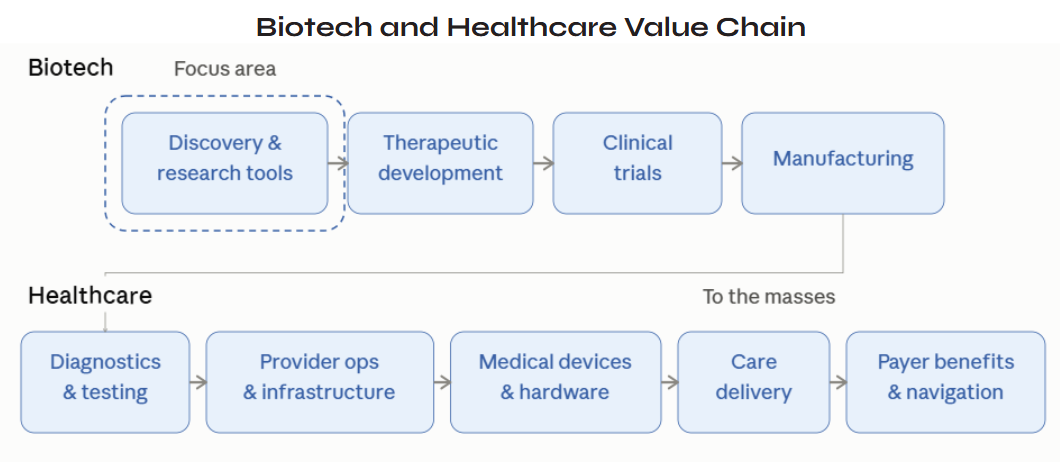
Since frontier AI labs are entering the space and partnering with big pharmaceutical companies that have clinical data from decades of running trials, the question is where AI + biotech – often dubbed “techbio” – startups will be able to generate and capture value in the long term (what constitutes a moat), and which startups are the most threatened by these big players.
Big AI Labs - Friend or Foe?
One of the most popular launches in the Discovery space the last few months actually came from frontier AI Labs. Anthropic unveiled Claude Science, a “workbench” that integrates over 60 computational biology tools – including those from companies like Benchling, LatchBio, 10X Genomics, NVIDIA, and Basecamp Research – through natural language.
The company also announced that it will be developing its own clinical assets for rare disease. It acquired Coefficient Bio, a drug-development operations startup, for $400 million and put Novartis CEO Vas Narasimhan on its board.
For its part, OpenAI shipped Rosalind, a reasoning model for early drug discovery with plugins to 50+ tools/databases such as AlphaFold, PubMed, and UniProt. Together with Codex and ChatGPT, this is also a workbench that enables target ID, genomics, protein reasoning, literature synthesis, and hypothesis generation in one place.
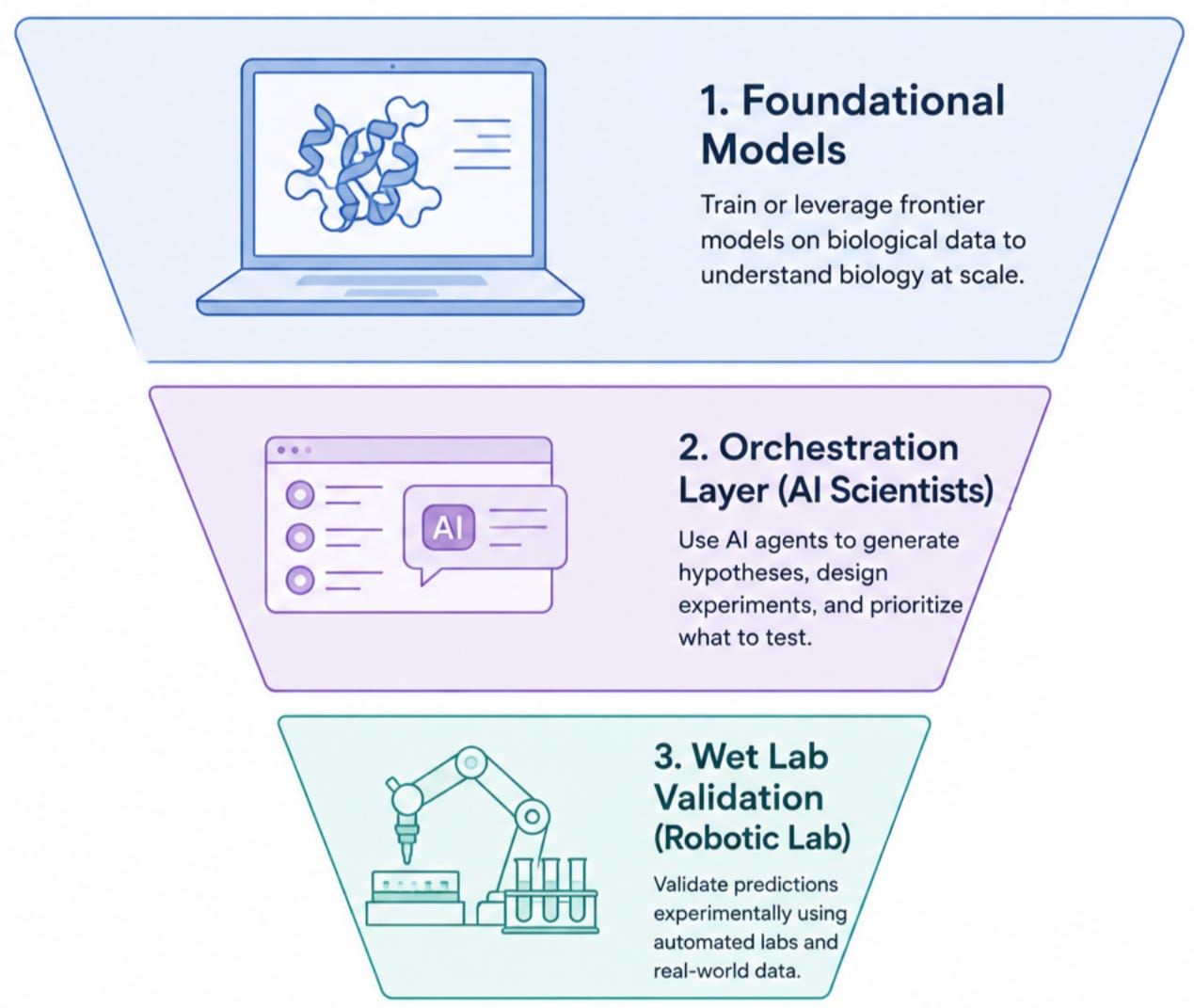
Thinking of these tools as threats to all AI discovery tools / startups usually stems from a misunderstanding of the value that frontier AI labs bring to scientists.
There is no indication that Anthropic or ChatGPT aim to develop their own foundation models for biology. Rather, they are buying biological data generated by small biotechs since it can improve their general models as well as their scientific capabilities. These workbenches act like general AI life science assistants instead of biology-specific foundation models.
Private company integrations (e.g. Benchling, 10X Genomics, Basecamp Research, etc) work through the open-source Model Context Protocol (MCP) and plug into Anthropic and OpenAI. Both commercial and non-commercial users can access the connectors, users may independently pay for those tools (price dependent on each company’s business model). Companies like Benchling and Basecamp may already view the LLM workbenches as a distribution channel rather than a competitor.
So who IS building a Foundational Model for Discovery
Foundation models for drug discovery vary depending on the drug modality.

Proteins
Proteins are part of one drug segment known as “biologics” – which also includes antibodies (a type of protein), peptides, DNA and RNA – Out of 46 drugs approved by the FDA in 2025, 26% were proteins, with monoclonal antibodies (mAbs) being the dominant protein category.
Open source protein foundation models like Alphafold, RosettaFold and ESMFold were possible thanks to publicly available data gathered over decades of experimentation. They have reasonable traction among scientists globally and, perhaps with LLMs serving as a bench scientist that can translate things into layman’s terms, we will see more usage expand to a broader scientific community.
With the pure foundational model being fairly mature here, the moat lies in companies that are building wet-lab flywheel to close the design-build-test-learn loop with proprietary data — continuously fine-tuning closed models on results the public datasets don’t contain, and pushing into modality-specific problems. Some interesting players in the protein space are Basecamp Research, Profluent, and Asimov.
Small Molecule
Small molecules remain the dominant drug modality in the pharmaceutical industry today, accounting for 58% of FDA approved drugs in the past five years. Early stage venture funding for this category has remained constant at $2.5 billion throughout 2024–2025.
Small molecule discovery tools include structure-based screening (testing many candidate molecules against the protein’s 3D shape to see which fit) and docking (computationally predicting how and how well a specific molecule would fit into that pocket).
Unlike protein structure prediction, in small molecule discovery, tools for high-accuracy binding site identification are less readily available in open source models. However, they have been under development for a longer time and thus, public companies like Schrödinger, Recursion Pharmaceuticals and Insilico Medicine with over a decade of experience in the field are heading faster than their protein counterparts towards the first-ever fully-AI-designed drug to be approved in history.
Throughout the last 6 years, ~80% of Schrödinger’s revenue has come from pure software licensing, growing 25% from 2023 to 2025. After a multi-year alliance between Schrödinger and Nimbus Therapeutics (cofounded by Schrödinger’s CEO, Schrödinger owns equity), they successfully finalized Phase III trials for the drug Zasocitinib this year.
This news validates the economics of the hub-and-spoke model — Schrödinger’s equity stake converted into $147M in realized cash — even if it captured only a fraction of the deal’s headline value and didn’t require a genuinely novel AI-discovered target.
AI Scientists and Heightened Competition
Companies that offer “scientific agents” or “AI scientists” as a service without any in-house capacity for experimentation (wet lab flywheel) will have a tougher time establishing a moat. Core value propositions around literature review, data analysis, hypothesis generation, and target identification are squarely in the cross-hairs of the large generalist AI labs and their open source integrations.
Furthermore, when dozens of companies develop an AI + wet lab platform for the same drug modality (small molecules and antibodies particularly), it becomes hard to capture value through licensing or asset codevelopment. The most intuitive strategy is to focus on new modalities, such as next-generation antibodies (ADCs, TCEs, bispecifics) that competitors will not easily have data for. Thus, the flywheel and the data it generates may be one of the only moats left for techbio startups.
A Standalone Validation Layer: Cloud Labs
Cloud Labs offer autonomous experimental validation or data generation as a service for biotech startups and larger pharmaceutical companies. Companies like Adaptyv ($8MM seed in 2025) and Ginkgo Bioworks (NYSE: $DNA) are especially positioned to provide this layer for software-only companies like Chai Discovery, Cradle, Latent Labs, and recently Anthropic too.
Companies that are not inherently built as data factories will likely benefit more from focusing on their proprietary pipeline long term instead of giving away IP for short term contracts that may change as AI labs go public.
It is possible that pure-software platforms like Chai Discovery, Cradle and Latent labs work with dedicated cloud labs, at least as a start. Despite being vertically integrated and owning automated lab-in-the-loop platforms, big pharma can also use cloud labs for non-core or specialized work. One example is Eli Lilly having an in-house Life Sciences Studio and still generating close to 20% of its screening compounds through Strateos (in 2021).
Summary
Frontier labs (Anthropic, OpenAI) are commoditizing the orchestration/tooling layer. Big pharma is commoditizing compute + their own historical data by writing billion-dollar checks to Google/NVIDIA/OpenAI directly. Public companies that focus on small molecule discovery and development (Recursion, Schrödinger, Insilico) have assets in late clinical stages and still earn mostly through software licensing, while the best-performing protein folding models tend to be open-source. That leaves a shrinking middle where a startup’s only genuine claim to value is data or capability neither of those two giants can just buy or build, which can naturally orient us to new modalities like cell and gene therapy or next-generation antibodies.
The moats we look for are a wet lab flywheel producing data that doesn’t exist anywhere else, and foundational models for modalities that aren’t as open-source or commoditizable but feasible through the same flywheel.