

Introduction
Existing cybersecurity paradigms were built for a human-governed world. Software, identities, infrastructure, and dependencies grew at a scale human teams could reasonably manage, while attackers were constrained by the same human effort. This created a rough parity of between offense and defense, allowing human-driven workflows to remain the primary control mechanism. That parity was the foundational assumption underlying the modern security stack.
Frontier AI models and agentic frameworks are breaking that parity. Software can be produced and systems operated at machine scale, while attackers can automate vulnerability discovery, exploit generation, and execution across thousands of targets in parallel. Defenders have access to the same underlying capabilities, but remain constrained by legacy workflows, human approval, and the higher reliability threshold required to act autonomously in production. The result is a widening gap: both the volume and velocity of the systems being secured and the attacks against them are beginning to exceed what human-driven security can govern.
The security response to this shift is beginning to take a consistent shape. As scale and velocity overwhelm controls designed around periodic inspection and human intervention, security is moving closer to the systems, decisions, and actions it governs. Human judgment is moving in parallel, out of high-volume work that can increasingly be automated and toward consequential decisions where authority remains important. Security relocates to the control point; human judgment relocates to the consequence point.
That relocation is the through-line of this thesis. To understand where these shifts are occurring and what they mean for the security market, we first map the Cyber Attack Chain as it exists today.
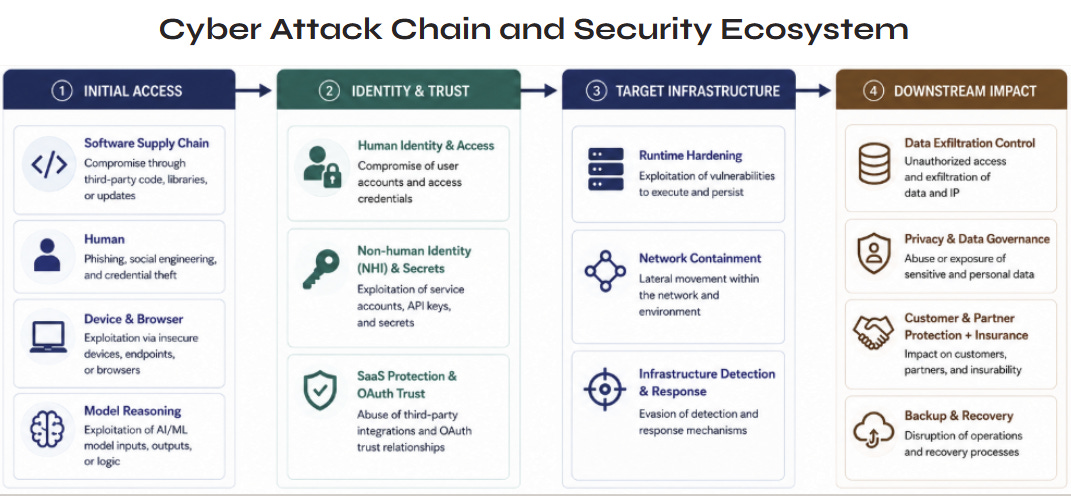
First, we must understand the attack chain component which illustrates the typical sequence of a modern intrusion. The chain consists of four stages:
Initial Access — gaining an entry point through the software supply chain, phishing, vulnerable code, devices, or other exposed assets.
Identity & Trust — abusing human or non-human identities, credentials, permissions, and trust relationships to expand access.
Target Infrastructure — interacting with the systems where workloads, applications, and data reside.
Downstream Impact — achieving the attacker’s objective, such as data exfiltration, ransomware, disruption, or persistence.
This ordering reflects how an attacker progresses, not necessarily how security products are marketed.
Cross-Cutting Security Functions

Second, there are three main layers which span across the entire attack chain rather than embodying a single stage:
Exposure Management (CTEM) continuously discovers, validates, and prioritizes weaknesses before they are exploited.
Security Operations (SecOps) detects, investigates, and responds to threats throughout an attack.
Governance, Risk, and Compliance (GRC) defines policies, manages risk, and ensures regulatory compliance across the organization.
These functions provide organization-wide visibility and coordination, making them cross-cutting capabilities rather than point solutions.
With this framework in place, we can better understand how today’s inflections propagate across the security landscape.
Today’s Inflections, Downstream Effects, and Responses
The rise of AI is reshaping the scale, speed, and architecture of enterprise technology. Across software production, security decision-making, identity, and AI infrastructure, these shifts create downstream effects that challenge the assumptions underlying the existing security stack.
Downstream Effect 1: AI collapses the cost and time of producing software
AI does not simply increase developer productivity; it exponentially increases the rate at which both software and software risk can be created. As the marginal cost and time required to produce code collapse, the volume of software that must be secured expands while the time available to evaluate each change contracts. Software composition is one of the clearest areas where this pressure is already emerging.
This creates two problems for existing security workflows: volume and novelty. When an AI agent can generate thousands of lines of code across many files, the volume and velocity of changes overwhelm security checkpoints designed around occasional human commits. At the same time, agents are not simply introducing known dependencies; they are generating new application logic. A post-hoc scan can identify a vulnerable library, but it is less equipped to determine whether an agent just introduced a novel logic flaw into first-party code.
Software Composition:
To solve this, companies are now moving the checkpoint inside the coding workflow itself, evaluating code as it is generated, before it is even committed. This reflects the broader shift described above: security moving from external, post-hoc inspection toward the point of decision and execution.
This requires security tooling to operate alongside the coding agent, evaluating code and dependencies as they are introduced and remediating risk before it propagates downstream. The result is a shift from post-hoc scanning to in-line prevention, favoring platforms that integrate directly into developer and agent workflows and operate at the speed of autonomous software generation.
Several enabling technologies are making this shift possible, with a new generation of platforms already putting them into production.
Companies like Endor Labs combine dependency and call graphs, function-level reachability, dataflow analysis, and agentic code reasoning to determine whether vulnerabilities are actually exploitable across first-party and third-party code.
Socket applies behavioral package analysis to identify malicious dependencies based on signals such as network, filesystem, and shell access, blocking risky packages before installation, while increasingly layering in reachability to reduce vulnerability noise.
Together, these technologies provide the context required to move application security from periodic scanning toward continuous, in-line evaluation as software is generated.
Downstream Effect 2: Humans are the New Bottleneck
As discussed in the previous section, we are seeing a wide encompassing timeline acceleration as a result of AI. Right beside software production, AI has collapsed the cost and time required to discover and exploit vulnerabilities.
Discovery is no longer the primary constraint. On the offensive side, AI agents can scan entire codebases, identify vulnerabilities, generate exploits, and iterate across thousands of targets in parallel; on the defensive side, they can continuously discover, triage, and prioritize vulnerabilities at similar scale. As both sides accelerate from human to machine speed, the limiting factor for defense shifts from finding threats to responding to them — decision latency. Decision-making remains constrained by human speed, making human judgment the new bottleneck in the security response cycle.
This creates a tension in how cybersecurity work should be divided between humans and machines. Since AI can accelerate nearly every stage of the security workflow, humans should naturally be removed from the loop wherever their judgment is not required. High-volume, repeatable workflows — triage, investigation, and routine remediation — will increasingly be automated, eliminating human latency as a constraint on defensive speed. But automation should stop at consequential decision boundaries, where humans remain the gatekeeper for actions carrying meaningful risk. OWASP similarly recommends human approval for high-impact agent actions and, in its emerging human-oversight framework, formalizes approval gates, escalation triggers, intervention mechanisms, and mandatory human decision points before irreversible actions.
The path to a more secure system is therefore not eliminating the human from the loop, but maximizing the leverage of human judgment within it — another manifestation of the broader shift toward the point of decision and execution. The objective is to concentrate that judgment where it carries the most value: automating for scale while retaining human control over critical decisions.
This creates opportunity on both sides of the human-bottlenecked decision boundary. On one side, AI-SOC and autonomous remediation platforms seek to remove humans from high-volume operational work. Companies such as Exaforce and Prophet Security are already automating alert triage, investigation, threat hunting, and response, while incumbents are pushing similar capabilities into existing SecOps platforms. We view this as a large but competitive extension of the existing Security Operations layer rather than an entirely new category.
On the other side, autonomous systems require infrastructure that determines when execution must stop, escalate, or obtain additional authority. These controls include scoped authorization, approval gates, delegation, intervention, and auditable enforcement at the point where an action is taken. Emerging platforms such as Keycard are building agent-specific authorization and policy enforcement, while adjacent identity, PAM, cloud, and execution platforms have natural expansion paths into the same control surface.
Given this convergence between approval infrastructure and the systems already responsible for authorization and execution, we are less convinced that human approval will emerge as a durable standalone category. Approval is likely to be embedded into the systems where actions are authorized and executed. The more differentiated problem is determining when human judgment is actually required and providing enough context for that judgment to be exercised efficiently. As agents gain greater authority and execute increasingly multi-step tasks, making that determination becomes less about a single action and more about understanding how the agent has behaved over time — a problem we return to below in Identity & Trust and Least Agency.
Conclusion
AI is compressing the timelines that the existing security paradigm was built around — collapsing how quickly software and risk can be created, and how quickly threats can be discovered and acted upon. In both cases, the response has not been to remove humans or reject automation wholesale, but to relocate the boundary: pushing security into the workflow itself where scale demands it, while concentrating human judgment at the narrower set of decisions where consequence demands it. This is the same relocation described at the outset — security moving to the control point, judgment moving to the point of consequence — now visible in two concrete places: the coding pipeline and the security operations cycle.
These are not the only places this relocation is occurring. The same pressures reshaping software production and decision-making are also reshaping identity and the infrastructure underlying AI systems themselves — areas we turn to next.